Not every coronary narrowing that looks significant on an angiogram is actually restricting blood flow. Treating a lesion that does not need treatment exposes the patient to unnecessary risk — while missing a functionally significant one leaves them undertreated. Coronary physiology solves this problem.
The angiogram is a picture — a two-dimensional shadow of the coronary lumen. It tells us how a lesion looks, but not how it behaves. A 50–70% narrowing on angiography sits in a grey zone: some of these lesions critically limit blood flow, others are harmless. To distinguish them, we measure the physiology directly using a pressure wire.
What Is FFR?
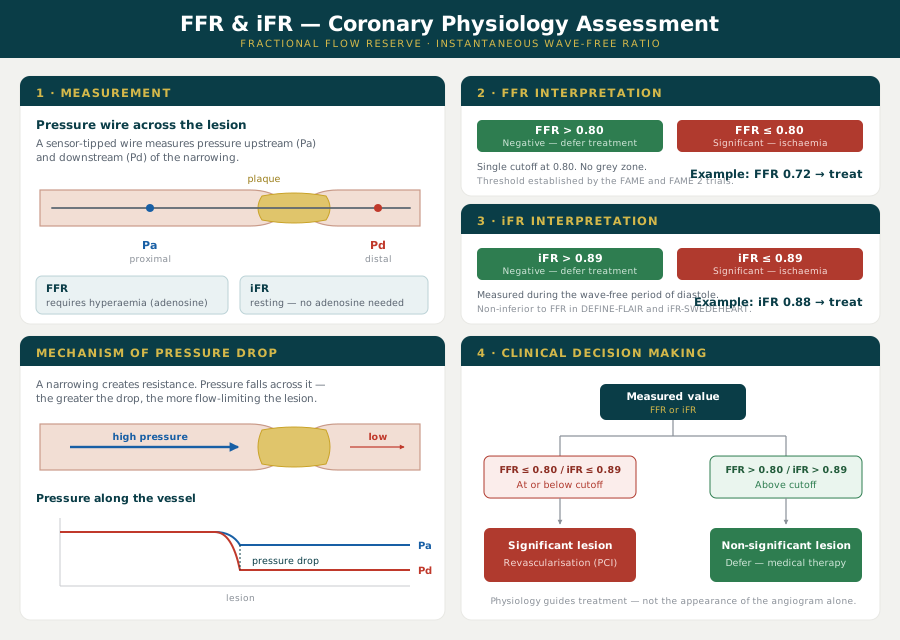
Fractional flow reserve (FFR) is the gold-standard invasive measure of whether a coronary lesion is causing ischaemia. A thin pressure-sensing wire is passed across the lesion, and a medication (usually adenosine) is given to induce maximal blood flow — a state called hyperaemia. FFR is the ratio of the pressure downstream of the lesion to the pressure upstream. A value of 0.80 or below indicates a functionally significant lesion that will benefit from treatment.
FFR is backed by a large body of evidence — the FAME trials showed that FFR-guided PCI improves outcomes and reduces unnecessary stenting compared with angiography-guided decisions.
What Is iFR?
Instantaneous wave-free ratio (iFR) is a newer physiologic index that measures the pressure ratio across a lesion during a specific resting phase of the cardiac cycle — the wave-free period — without the need for adenosine. This makes iFR faster, more comfortable for the patient (adenosine can cause a brief but unpleasant flushing sensation and breathlessness), and simpler to perform. An iFR value of 0.89 or below is considered significant.
The DEFINE-FLAIR and iFR-SWEDEHEART trials demonstrated that iFR-guided treatment is non-inferior to FFR-guided treatment in terms of clinical outcomes — establishing iFR as a validated alternative.
"Physiology transforms the angiogram from a picture into a decision. It stops us treating lesions that don't need it — and ensures we don't miss the ones that do."
— Dr. Zaidoun Hajali, MD FSCAI FRCPWhich One Should Be Used?
Both are validated and both are excellent tools. FFR has the longer track record and the larger evidence base. iFR offers speed and patient comfort by avoiding adenosine. In practice, many operators use iFR as the first-line resting measurement and reserve FFR for cases in the borderline zone or where additional confirmation is helpful. The choice often comes down to operator preference, the specific clinical scenario, and patient factors — for example, iFR is preferable in patients with severe respiratory disease who tolerate adenosine poorly.
Why This Matters for Patients
If your cardiologist recommends a pressure-wire study during your angiogram, it means they are committed to treating only what genuinely needs treatment. A lesion that is not physiologically significant is generally best managed with medications rather than a stent. This precision protects you from the risks of unnecessary procedures while ensuring that flow-limiting disease is properly addressed.
- The angiogram shows how a lesion looks, not how it behaves — coronary physiology measures the actual impact on blood flow.
- FFR (fractional flow reserve) is the gold standard, measured during adenosine-induced maximal flow; ≤0.80 is significant.
- iFR (instantaneous wave-free ratio) measures resting physiology without adenosine — faster and more comfortable; ≤0.89 is significant.
- Major trials (FAME, DEFINE-FLAIR, iFR-SWEDEHEART) validate both approaches; iFR is non-inferior to FFR.
- Physiology-guided decisions reduce unnecessary stenting and improve patient outcomes.